
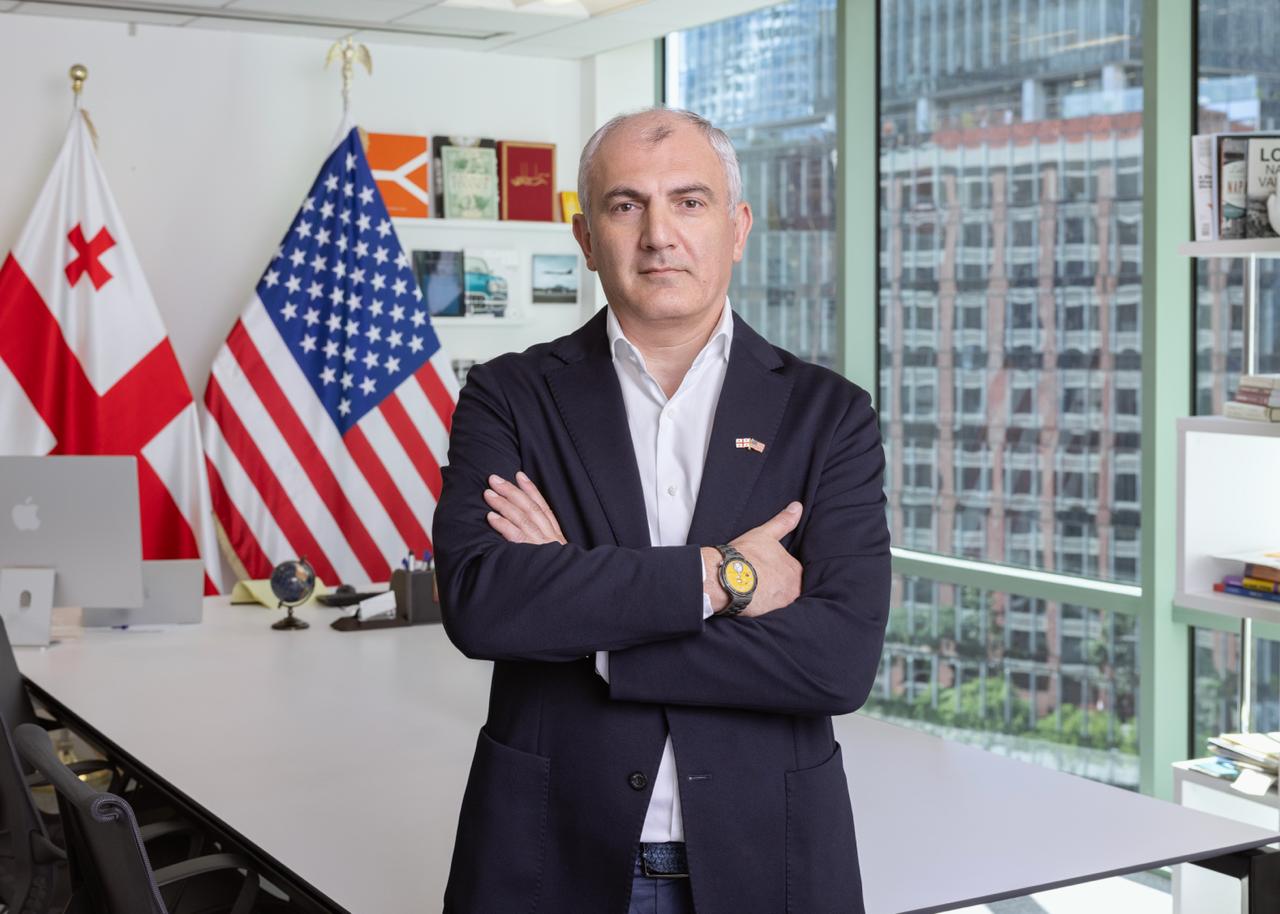
Six years after opening in 2020, Georgia’s Consulate General in San Francisco has evolved into a platform for startup and investor connections through the Georgian Innovation Hub. The Hub officially opened in June 2026, marking a new chapter in Georgia’s engagement with Silicon Valley. Led by former fintech executive Levan Kulijanishvili, the effort reflects a broader shift: diplomacy becoming part of the global innovation economy.
Author: Anina TepnadzeYou spent 27 years in fintech before stepping into diplomacy. What made you believe that background was actually an advantage in this role and has it proven to be?
When I stepped into diplomacy, it didn't feel like a completely new career. It felt more like applying the same mindset in a different environment.
My career in fintech started from the ground up. I didn't begin as an executive — I learned the business layer by layer: operations, systems, regulation, people. That kind of path builds curiosity and the habit of solving problems in complex environments. Entrepreneurs think in similar terms — experimenting, moving quickly, focusing on building things that work.
Coming from the private sector helped because founders and investors quickly recognize when someone understands how companies are actually built. Speaking that language came naturally, and it opened doors that a more traditional diplomatic approach probably wouldn't have.
Most consulates operate quietly in the background. Was there a specific moment when you realized this office needed to function more like a platform than a traditional diplomatic post?
Consulates do an enormous amount of work that most people never see—supporting citizens abroad and managing complex operations. That part of diplomacy is essential.
At the same time, the decision to open a Consulate General in San Francisco in 2020 reflected something bigger. The Georgian government took a forward-looking view toward technology and innovation — opening a diplomatic presence in Silicon Valley was a deliberate choice. Not just to observe the technology revolution, but to participate in it.
The support and leadership of the Ministry of Foreign Affairs played a key role in recognizing that opportunity. Five years after the consulate opened, Georgia made another strategic investment in its presence here by launching the Georgian Innovation Hub at the consulate — creating a dedicated platform where founders, investors, and partners can connect.
The Hub officially opened in June 2026 with a ceremony led by Georgia’s Deputy Prime Minister and Minister of Foreign Affairs. More than 250 guests attended, including leaders from Silicon Valley’s technology community, CEOs of global technology companies, members of the diplomatic corps, representatives of the Governor’s Office, and the Georgian diaspora. The opening also featured remarks from San Francisco Mayor Daniel Lurie, Plug and Play Founder and CEO Saeed Amidi, and Rakuten International CEO Amit Patel, reflecting the broad coalition supporting Georgia’s growing innovation presence in Silicon Valley.
The launch was the culmination of two years of building relationships across Silicon Valley. Through the events we hosted, we consistently brought together founders, investors, engineers, academics, business leaders, and diplomats in the same room. That's when we realized the consulate could become more than a diplomatic mission, it could become a platform where innovation ecosystems meet. That vision ultimately became the Georgian Innovation Hub.
Georgia remains the only country from the broader region with a diplomatic presence in Silicon Valley that combines traditional diplomacy with a dedicated innovation platform.
The Georgian Innovation Hub is an unusual idea, turning part of a consulate into a space where founders and investors actually meet. Where did that concept come from, and what does it look like in practice?
One thing you quickly notice about Silicon Valley is that it's a very community-driven ecosystem. Many of the most important opportunities start with simple introductions.
For founders from outside the United States, that part can be the hardest to access — it takes time to understand where conversations happen and how to join them. The Hub became a kind of clubhouse inside the consulate, where access became a little easier.
We also started noticing something unexpected: founders from across the broader Eurasian region were showing up at our events - not only from Georgia but also from neighboring countries. Many of them were looking for the same thing: a way to understand Silicon Valley better and build a presence here. That realization became the foundation for the Hub. In Silicon Valley, access to the network often determines whether an idea becomes a company.
"Georgia has an exciting and growing startup ecosystem. Through Levan's leadership and the work of the Consulate, we have seen stronger connections forming between Georgia and Silicon Valley that are creating real opportunities for founders and innovation." — Saeed Amidi, Founder & CEO, Plug and Play.
If you had to pitch Georgia's tech ecosystem to a Silicon Valley VC in sixty seconds — someone who has never thought about the Caucasus — what do you lead with?
Sometimes I start with a thought experiment. If you asked an AI to analyze the history of a country that went through centuries of invasions and occupations, it might conclude that the country shouldn't exist today. Yet Georgia does. So the first thing I talk about is resilience — because that mindset naturally carries into entrepreneurship.
Then I explain geography. Georgia sits at a crossroads between Europe and Asia. Historically, it was part of major trade routes, and today it can play a similar bridging role between emerging ecosystems and established technology markets.
I often find that many people in Silicon Valley already know Georgia. I've met senior executives from major tech companies who, before I could even introduce the country, told me they'd already visited and fallen in love with it. Georgia is still under the radar for many investors, but the signals are starting to change.
When you sit down with investors, what's the one data point that consistently surprises them?
The biggest surprise is usually how modern and simple the business environment actually is.
Many people hear "post-Soviet region" and expect heavy bureaucracy. Instead, they find a country where you can register a company in hours, where most government services are digital, and where regulation is intentionally designed to be lightweight for entrepreneurs. Georgia has also introduced tax incentives for innovative startups and R&D companies, allowing founders to reinvest more capital directly into building products.
And moments like Bank of Georgia's recent inclusion in the FTSE 100 also shift perceptions. When investors see a company with Georgian roots appearing alongside some of the world's largest companies on the London Stock Exchange, curiosity about the country tends to follow quickly. The real surprise is the gap between perception and reality — and once investors see that gap, the conversation shifts from curiosity to opportunity.
With engineering costs in San Francisco at an all-time high, how do you position Georgia's talent pool? Is the story just about cost?
Cost efficiency may attract attention initially, but it's not the main reason companies look at Georgia. A stronger signal is already being shown by Georgian companies in the region. Two of the country's leading banks and a major automotive company have expanded operations into Central Asia and the Caucasus, setting new standards in their sectors. That kind of regional expansion simply doesn't happen without a strong talent base behind it. Cost may open the door, but capability is what keeps companies building here.
What private-sector habits have you brought into the Consulate — things that wouldn't typically exist in a government office?
Coming from banking, I naturally look at things through the lens of results.
In the private sector, activity matters less than outcomes. After any meeting, the real question is simple: what changed? Did something actually happen because of that conversation? That mindset shapes how I approach this role. We don't measure success by the number of meetings or events we host. What matters is whether founders meet investors, whether partnerships start, and whether new opportunities emerge from those interactions.
People often expect diplomacy to move slowly. My instinct is usually the opposite.
Six years in — what tangible outcomes are you most proud of?
What I'm most proud of is that Georgian founders are now showing up in conversations where they were rarely present before.
We've built a network around Georgia's tech ecosystem, bringing together founders, investors, operators, and partners who are genuinely interested in the region. Whether it's hosting conversations during Tech Week SF, representing Georgia at CES, or building relationships with institutions such as Draper University, Plug and Play, and 28 Digital, the goal has always been the same: to ensure Georgian founders are part of the global innovation dialogue.
"The Georgian Innovation Hub plays an important role in connecting emerging innovation ecosystems with global hotspots like Silicon Valley. Building bridges between regions such as Europe, Eurasia and Silicon Valley can unlock significant opportunities for startups, universities and industry." — Federico Menna, CEO, 28 Digital.
Do you think innovation diplomacy is becoming permanent, or is what you're doing here still the exception?
I don't think this is the exception anymore. I think this is where diplomacy is going.
For a long time, diplomacy was built around politics, trade, and security. That still matters. But today, influence is also shaped by who builds the next technology platform, where founders choose to launch, where capital flows, and where top talent wants to live and work. If you look at Silicon Valley now, it's not only a place where companies are built — it's a place where the future is negotiated in real time.
Countries that understand this early will have an advantage. You can already see it here: Italy, Austria, and Switzerland have all built their own models for engaging with the ecosystem. We took inspiration from that, but wanted to build something that reflects Georgia's own character and ambition.
In the future, diplomacy won't only be about representing a country. It will be about positioning a country inside the networks where the future is being built.
When someone in Silicon Valley meets you for the first time, what tends to surprise them most?
Conversations here rarely stay where they start. What begins as a discussion about diplomacy almost always ends up somewhere between startups, venture capital, and Georgian wine.
I sometimes remind people that Georgia introduced one of the world's earliest technologies thousands of years ago: winemaking. In many ways, we're still applying that same spirit today — helping build companies and connecting two parts of the world that have more in common than either of them yet realizes.
What do you want the next generation of Georgian founders to take from what you've built here?
We built the foundation. The next generation of Georgian innovators will belong here. The door is open. Walk through it.